A personalised Human Design reading, your energy type, authority, life theme, and a direct conversation about whether this path is right for where you are now. No sales pitch. No strings.
Your body has been talking to you your entire life. Here's what it's been saying.
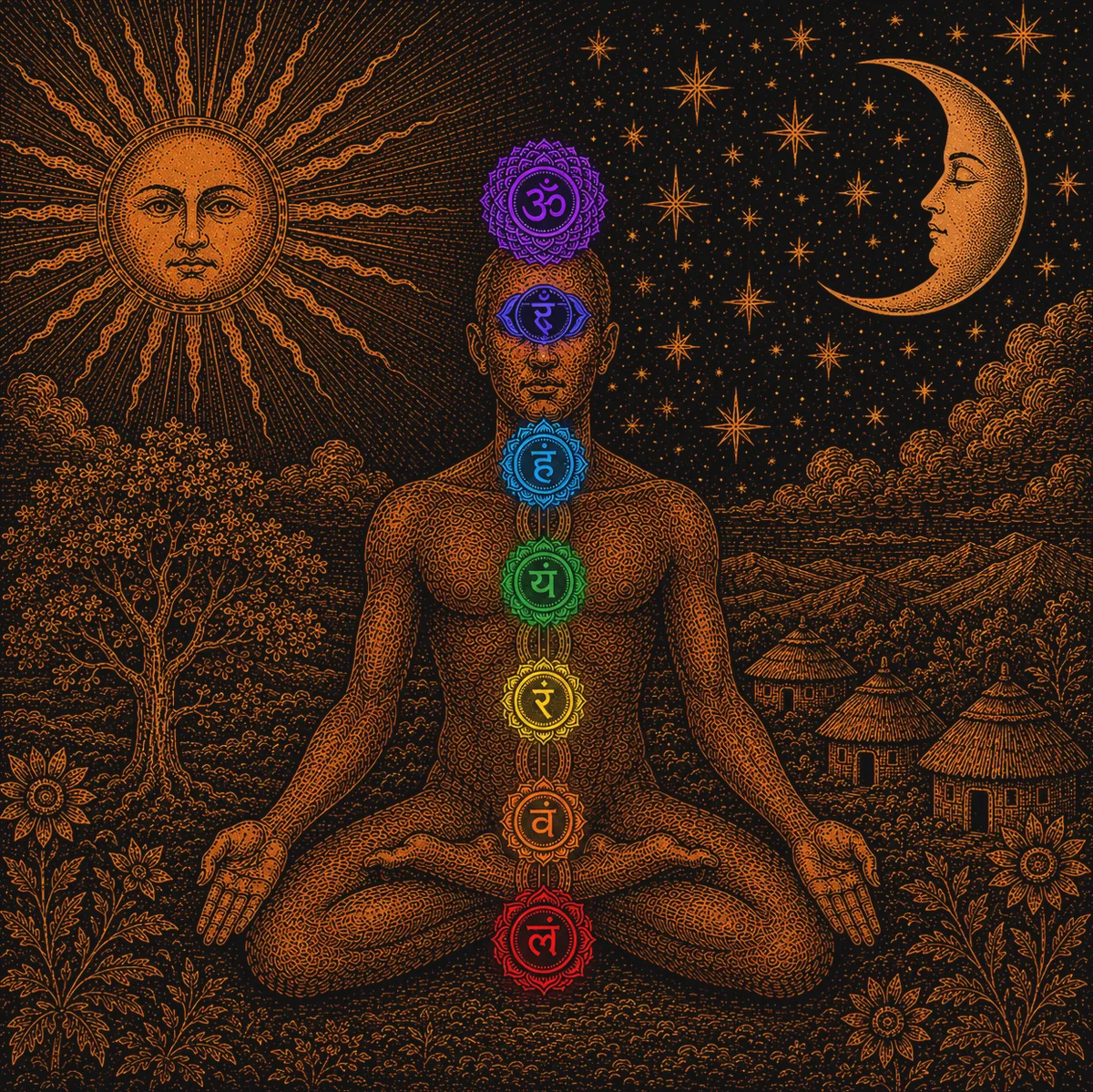
You already know this system. You've felt your stomach drop before a hard conversation. Your chest tighten when someone said something true. Your throat close when you swallowed words you needed to say. Your body has been mapping your experience into specific locations your entire life. You just never had a key that told you what the locations meant. Some traditions call these chakras. Some call them energy centers. Call them whatever you want. What matters is that when you know the geography, the body's signals stop being vague discomfort and start being specific information.
01
Root
Survival
Base of the spine, legs, feet
When the ground feels unstable, everything else becomes noise.
This is the most fundamental region. It processes everything related to staying alive: food, shelter, money, physical safety, your relationship with the material world. When this center is activated, nothing else matters to your nervous system. You can't think about relationships or purpose or truth when your body is running a survival program. It takes over everything.
1/4
What It Feels Like
Heaviness at the base of the spine. Tension in the legs. Restlessness that makes you unable to sit still, or the opposite, a freeze response where you can't move at all. Financial anxiety often registers here as a literal weight pulling downward. The body is telling you: something about your foundation feels threatened.
When It's Running a Pattern
Most survival patterns were installed early. A childhood where resources were unstable, where safety was conditional, where the ground could shift without warning. Those patterns keep running long after the actual threat is gone. You're financially stable but your body still clenches around money. You're physically safe but your system stays braced for impact. The pattern isn't responding to now. It's responding to then, using now as the trigger.
What It Sounds Like in Daily Life
Hoarding resources or spending impulsively (both are survival responses, just opposite poles). Difficulty relaxing because the body won't release its vigilance. Making decisions from fear of loss rather than genuine direction. Staying in situations that are wrong for you because leaving feels like a threat to survival.
Reading the Signal
When you feel activation in this region, the question is: am I actually in danger right now, or is my body running an old program about danger? That distinction is everything. If the threat is real, the signal is doing its job. If the threat is stored, the signal is a pattern announcing itself. That's when Real-Time Pattern Interruption becomes available.
02
Sacral
Relationship and Response
Lower abdomen, below the navel
This is where you meet the world. And where the world meets you.
The sacral center processes how you relate to everything outside yourself. Other people, pleasure, creativity, desire, the basic question of "does this pull me toward it or push me away?" This is the seat of your response mechanism. Before your mind has an opinion, this region has already opened or closed.
1/4
What It Feels Like
Warmth or contraction in the lower belly. A pull toward something or a closing against it. Gut feelings live here, literally. Sexual energy, creative impulse, and relational chemistry all register in the same region because they're all expressions of the same function: your body's response to contact with the world.
When It's Running a Pattern
Sacral patterns usually involve boundaries. Saying yes when the body said no. Staying open to people or situations that your gut closed against. Performing desire you don't actually feel. Or the reverse: shutting down response entirely because past openness led to harm. The sacral center is where people-pleasing lives, where codependency installs, where the body's honest response gets overridden by the mind's social calculations.
What It Sounds Like in Daily Life
Overcommitting because you can't feel the "no" anymore. Staying in relationships that your body left long ago. Difficulty accessing creativity because the creative channel runs through the same center that got shut down for other reasons. Feeling drained after social interaction because you were absorbing other people's energy through an open relational field.
Reading the Signal
The sacral response is binary. Open or closed. Toward or away. The signal is actually one of the clearest in the body, but it's also one of the most overridden. Most people learned early that their "no" wasn't acceptable, so they stopped feeling it. Restoring access to this signal is foundational work. It starts with noticing: before you say yes to anything, check the lower belly. Is it opening or closing? Trust the body's answer even when the mind disagrees.
03
Solar Plexus
Self and Power
Upper abdomen, stomach, diaphragm
The distance between who you are and who you're performing is stored right here.
This center processes your relationship with yourself. Your sense of personal power, your will, your confidence, your ability to act in the world as who you actually are rather than who you think you need to be. It's where you feel the difference between authentic strength and performed strength. And it's where the cost of performance registers most clearly.
1/4
What It Feels Like
Butterflies, nausea, a knot in the stomach, a sinking feeling, or the opposite, a fire in the belly that wants to move. Stage fright lives here. So does shame. So does genuine courage. They all process through the same region, which is why it can be confusing. The signal is strong but it requires accurate decoding to know whether the activation is fear, excitement, shame, or power.
When It's Running a Pattern
Solar plexus patterns are about the performed self. Dimming yourself to make others comfortable. Inflating yourself to compensate for feeling small. Working obsessively to prove your value. Avoiding visibility because being seen feels dangerous. All of these are patterns about how you present yourself to the world, and all of them register as tension or collapse in this region.
What It Sounds Like in Daily Life
Workaholism as identity. Inability to rest without guilt. Shrinking in the presence of authority figures. Dominating conversations to maintain control. Stomach problems that flare during periods of self-doubt or public exposure. The solar plexus holds the question "am I allowed to take up space?" and most people's bodies answered that question decades ago based on conditioning that may no longer apply.
Reading the Signal
When you feel activation here, ask: am I performing right now? Am I being larger or smaller than I actually am? The solar plexus tells you when you've left your actual size. The knot means you're compressing. The fire means something wants to express. Neither is wrong. Both are information. The practice is learning to return to your real size, whatever that is, and letting the tension release.
04
Heart
Love and Rhythm
Center of the chest
The heart doesn't just feel. It cycles.
The heart center processes love, compassion, gratitude, recognition, and expansion. But it also has a rhythm. It opens and closes. It expands and contracts. Love has seasons. Connection has tides. The heart is where you feel the pulse of your emotional life, and where you learn that the contraction is part of the cycle, not a sign that something is broken.
1/4
What It Feels Like
Warmth spreading through the chest. A physical ache when you miss someone. Tightness when you're guarding against vulnerability. The sensation of your chest literally expanding when you encounter beauty or kindness. Grief lives here as heaviness. Joy lives here as lightness. Both are real. Both pass.
When It's Running a Pattern
Heart patterns usually involve guarding. You were hurt, so the body learned to close the chest. The closing was intelligent at the time, it protected you. But the pattern keeps running long after the threat has passed. You meet someone safe and the heart still braces. You receive a compliment and the chest tightens instead of opening. You want to express love but something in the body holds it back.
The other pattern is overextension. Giving without receiving. Loving without boundaries. Keeping the heart open past the point of depletion because you learned that closing meant being selfish. Both guarding and overextending are patterns. Neither is the heart's natural state.
What It Sounds Like in Daily Life
Difficulty receiving help, compliments, or love. Giving everything to others and feeling empty. Staying emotionally guarded while performing warmth. Sudden grief that doesn't seem connected to anything current. Chest tension during intimacy. The heart is trying to tell you where you are in the cycle: open or closed, expanding or contracting, giving or receiving. The pattern is whatever prevents you from moving naturally between those phases.
Reading the Signal
The heart's rhythm is not meant to be constant. You are not supposed to be openhearted every moment of every day. Contraction is rest. Contraction is how the heart protects and recalibrates before the next expansion. The signal to watch for is when the contraction becomes permanent, when the chest stays tight regardless of what's happening, when the guard stays up even in safe conditions. That's the pattern. The natural state is movement between poles.
05
Throat
Voice and Truth
Throat, jaw, neck
Your voice is your frequency. What you won't say stays in your body.
The throat center is where your inner reality meets the outer world through expression. Speech, singing, writing, any act of putting what's inside into a form that others can receive. This is also where truth lives or dies. Every time you swallow something true, the body registers it here. Every time you speak something false, the body registers it here. The throat keeps score.
1/4
What It Feels Like
A lump in the throat before a conversation you're avoiding. Jaw clenching when you're holding back words. Tightness in the neck when you've been performing agreement you don't feel. Or the opposite: a clear, open sensation when you finally say the thing you've been sitting on. The relief of truth is physical. It releases the throat immediately.
When It's Running a Pattern
Throat patterns come from learning that your truth was unwelcome. You learned to edit yourself before speaking. You learned to say what was expected rather than what was real. You learned that certain truths were dangerous, so the body developed a gatekeeper that closes the throat before the words arrive. That gatekeeper was intelligent when you were six. It's running on outdated software now.
The other pattern is compulsive speech. Filling silence because silence feels threatening. Talking to manage other people's emotions. Using words to create a version of reality rather than to describe it. Both suppression and compulsion are throat patterns. Both register in the same region.
What It Sounds Like in Daily Life
Chronic throat clearing or coughing with no medical cause. Difficulty speaking up in groups. Saying "I'm fine" when you're not. Talking too much when nervous. Jaw pain from clenching. A feeling of something stuck in the throat that doesn't clear. The body is literally holding the unsaid, and it costs energy to keep holding it.
Reading the Signal
When the throat activates, the question is simple: what am I not saying? Not what should I say, not what would be appropriate to say, not what would be strategic to say. What is the thing I'm holding back? Sometimes the answer is "nothing, this is just tension." But often the throat is holding a specific truth. Naming it, even silently to yourself, releases the physical tension immediately. You don't always have to say it out loud to others. You do have to say it to yourself.
06
Third Eye
Perception
Center of the forehead, behind the eyes
You're not seeing reality. You're seeing the story your mind is telling about reality.
The third eye processes perception, how you construct your understanding of what's happening. This is where the narrator lives. Not the events themselves, but the interpretation of events. The framework you use to make sense of the world. When this center is clear, you see what's actually there. When it's clouded by conditioning, assumptions, or fear, you see the projection. Most people have never experienced the difference.
1/4
What It Feels Like
Pressure between the eyes when you're trying to make sense of something that doesn't fit your current framework. Headaches during periods of worldview change. A feeling of mental fog when your perceptual system is overloaded. Or the opposite: moments of sudden clarity where you see a pattern you've been inside of for years as if from the outside for the first time. Those moments of "I can't believe I didn't see this before" are the third eye clearing temporarily.
When It's Running a Pattern
Third eye patterns involve seeing what you expect to see instead of what's there. Confirmation bias is a third eye pattern. Projecting your past onto your present is a third eye pattern. Refusing to see something that would require you to change your self-image is a third eye pattern. The mind builds a model of reality and then defends the model against incoming information that doesn't fit. That defense registers as pressure, confusion, or the very specific headache that comes with cognitive dissonance.
What It Sounds Like in Daily Life
Being certain you know why someone did something without checking. Interpreting neutral events through a lens of threat. Difficulty seeing your own patterns while seeing everyone else's clearly. Clinging to a belief system that no longer matches your experience because letting go of it would mean rebuilding your entire worldview. The third eye becomes clouded not because perception is broken but because the mind prefers its existing model to the discomfort of updating it.
Reading the Signal
When you feel activation here, the question is: am I seeing what's actually happening, or am I seeing my interpretation of what's happening? This is the hardest center to read honestly because the mind doing the interpreting is the same mind you'd use to check the interpretation. It's the narrator evaluating its own narration. This is where the other tools help. The body map gives you ground truth. The sacral response tells you what's actually open or closed regardless of what the mind thinks. You cross-reference the third eye's story against the body's signal. When they disagree, trust the body.
07
Crown
Connection
Top of the head
This one isn't about understanding. It's about recognizing you were never separate.
The crown processes your connection to something larger than yourself. Call it god, source, consciousness, the universe, the field, whatever word doesn't make you flinch. This center doesn't care about language. It's the experience of being part of something you can't see the edges of. The dissolution of the boundary between you and everything else. Most people have had at least one moment of this, and most people have no framework for understanding what happened.
1/4
What It Feels Like
Tingling or pressure at the top of the head. A sense of expansion beyond the boundaries of the body. The experience of being both yourself and something much larger simultaneously. Tears that aren't sad, just full. Moments where the separation between you and the world briefly dissolves and everything feels connected. These experiences are often what brought people to ceremony or practice in the first place, and they're often what people are trying to get back to during integration.
When It's Running a Pattern
Crown patterns go in two directions. The first is spiritual bypass: using transcendent experiences to avoid dealing with the lower centers. Flying up to connection to escape the mess of survival, relationships, power, and truth. Using meditation or ceremony as avoidance rather than engagement. Chasing peak experiences instead of doing the daily work of living in a body.
The second is disconnection. Shutting the crown down entirely because the experience of something larger was too disorienting, too incompatible with your previous worldview, or too lonely when nobody around you understood what happened to you. Both are patterns. One uses the crown to escape the body. The other closes the crown to stay safe in the mind.
What It Sounds Like in Daily Life
Chasing the next ceremony or retreat instead of integrating the last one. Using spiritual language to avoid emotional honesty. Feeling disconnected from daily life because "ordinary reality" feels flat after peak experiences. Or the reverse: dismissing every spiritual experience as "just brain chemistry" because the alternative is too destabilizing. Feeling isolated because the experience changed you in ways that are difficult to share with the people in your life.
Reading the Signal
The crown doesn't need to be activated to function. It doesn't require ceremony, substances, or extreme practices. It's always connected. The work isn't opening the crown. The work is clearing what's between the crown and the rest of your system so the connection flows naturally into daily life instead of only appearing during peak states. That clearing happens through the other six centers. When survival is stable, relationships are honest, power is authentic, the heart cycles freely, truth is spoken, and perception is clear, the crown doesn't need special attention. It's already doing what it does.
·
The body already knows.
Closing
You don't need to memorize this map. You need to start paying attention to where you feel things and letting the location tell you what domain is active. The system is already running. It's been running your entire life. You're just learning to read what it's been saying.
This map becomes most useful in combination with the other tools here. The seven principles explain the mechanics behind what each center is doing. Human Design shows you which centers are defined in your specific system and which are open to other people's energy. Real-Time Pattern Interruption is how you catch a pattern when it fires in any of these regions.
But none of that is required to start. Start by noticing. Where do you feel it? What domain does that point to? Is this signal about survival, relationship, power, love, truth, perception, or connection? That question alone changes your relationship with what your body is telling you.
If this resonated, you might also find these useful: